


Ironmonger's shop left in ruins
A little artistic licence has been employed for that alarming headline, as the events described here happened many years before the Dolce Vita Italian Restaurant came to occupy its present position on Stockport Road, opposite the entrance to Memorial Park. However, as it easily identifies the location in question for the majority of local people, I hope that readers will forgive the deliberately misleading start to this article.
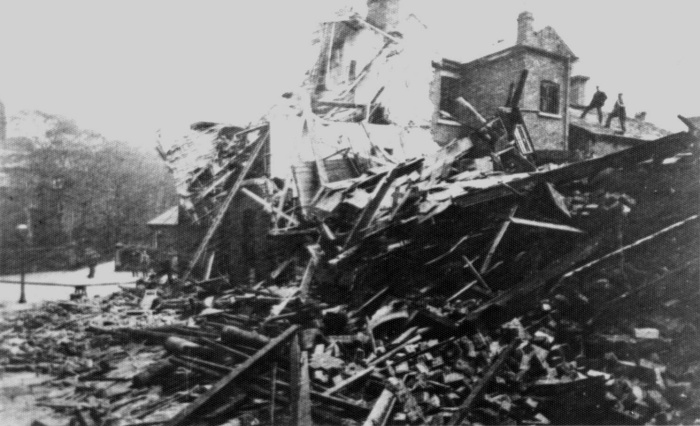
Devastation on Stockport Road in 1902
For several years this picture has been on the "Virtual Tour History Tour", showing the devastating results of an explosion at the ironmonger's shop trading in the building that used to be on this site but only recently did I learned that in Marple Local History Society's archives is a full Home Office Report describing exactly what happened. The report, written by Captain M. B. Lloyd, H.M. Inspector of Explosives, gives a fascinating insight into a tragic event that was rather more commonplace at the turn of the 19th Century than you might at first imagine.
James Lee and Sons, Ironmongers, New Road, Marple
In 1902 Messrs. James Lee and Sons, Ironmongers, occupied this prime location, which Captain Lloyd described as being "one of the two principal streets in the town". It was called New Road in those days, rather than Stockport Road, and the ironmonger's shop was a significant establishment covering all three floors of the large building. The business was managed by 30-year-old Robert Lee, one of the sons of James, the head of the family firm.
The premises were officially registered with the Local Authority for keeping mixed explosives, as were many similar establishments in those times. The ground floor of the building comprised the shop front, where customers were served, and a back room that was probably an office. On the first floor was a workshop used in connection with the bicycle department of the business and above this, on the second floor, was a storeroom containing a safe in which gunpowder was kept. The floor of this room was of open-jointed bare boards that had not been laid with any special care, and this proved to be of significance to the events that were to unfold one fateful Saturday evening in 1902.
Saturday 26th April 1902
At 7.30pm on Saturday 26th April, a stone merchant named George Baker visited the ironmongers to purchase four pounds of blasting powder. Robert Lee was the only person in the shop and he went to fetch the powder from the safe in the upstairs storeroom. Three minutes later, as estimated by Barker, there was a violent explosion and he ran out into the street, unhurt but somewhat shaken by the blast. Several people ran up at the sound of the explosion and Robert Lee was spotted at a first-floor window. The crowd coaxed him not to jump and someone fetched a ladder, which he managed to use to descend and make his escape. Soon afterwards his injuries were treated by a doctor, who was hopeful that Lee would survive, but on the 28th April, around 48 hours after the accident, he collapsed and died from the shock to his system.

The front of the shop after the explosion
Considering the size of the explosion it was quite remarkable that no one other than Lee was killed or injured by the blast. Children often played in the side street next to the building but there was a fair in town at the time and they had all gone to see the swings and roundabouts. In addition, due to it being Saturday evening, none of the workers who would normally be in the workshop below the storeroom where the powder was kept were present. Captain Lloyd speculates in his report, "had matters been in a normal condition, many personal injuries, and probably other deaths, would have resulted."
Due to Robert Lee surviving the initial blast it was relatively straightforward to ascertain the cause of the explosion and he made two statements before passing away. The first was to the doctor who treated him at the scene, who he advised, "Some powder had leaked out of the safe and exploded." The second was more detailed and was made to a Police Sergeant who visited him on the morning of the day that he died. To him Lee stated, "A man came in for some powder, I asked him 'What kind?' He said, 'blasting'"; he did not know the man's name; "I could not find the funnel and struck a match to look for it; I was two or three yards away from the safe when I struck the match. I remember nothing more. I had not opened the safe door."
The outcome of Captain Lloyd's investigations
Captain Lloyd's investigations revealed a number of bad practices and other circumstances that had culminated in the death of Robert Lee and the destruction of the premises, which, as can be seen from the photographs, were completely wrecked by the explosion. The damage done was increased by the nature of the goods stored over the back part of the premises, which were largely of bar and rod iron and other heavy ironmongery. When the building was shaken by the blast the heavy load on the upper floor caused it to collapse entirely and only the front of the shop was left standing.
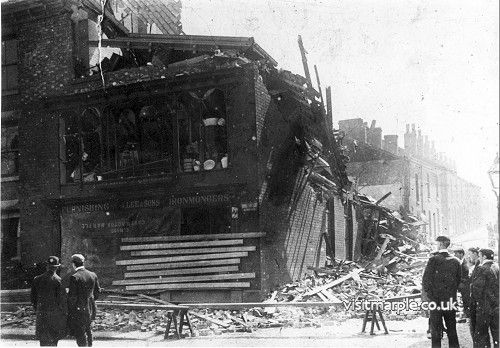
Crowds inspect the damage a little later
The Explosive Act, 1875, required that no package containing more than one pound of explosive should be opened on any registered premises unless all explosive therein is contained in inner packages. Small packages for retail purposes were readily available but this was a more expensive way to purchase stocks of explosive and was commonly ignored.
The practice for storing gunpowder at James Lee and Sons was to receive delivery in quarter barrels containing 25 pounds each. These were illegally decanted into canisters of around 15 pounds for storage in the safe and then decanted again into smaller containers from which the customer was served. Under these conditions the powder was exposed at least three times during its passage through the shop, with the operation being performed twice in the vicinity of the powder safe.
This practice had been going on for some years, and Captain Lloyd had no doubt that "grains of powder spilt in the operation would find their way into the cracks in the wooden floor, and so in time form trains of powder all over the room, leading to and culminating at the powder safe, where they would contain the most powder." Under these circumstances "even walking about the room in iron-shod boots would be attended with considerable danger, and still more dangerous would be the striking of a match, a spark from which falling on the floor would in all probability cause the explosion of all the powder in the room."
Investigations also revealed that the powder safe door was not bolted at the time of the explosion and that it was never locked. Captain Lloyd expounds at great length in his report how he considered this to be more dangerous than not keeping explosives in a safe at all! In his conclusion he states, "That the use of a fireproof safe under careful management is advantageous, but that in careless hands, and where the provisions of the Act are not observed, it increases the danger both to the public and to the personnel; and materiel of the premises."
The Captain's opinion, "that the explosion was attributed to the striking of a match in the room by the deceased" and that this "communicated" with the safe via the powder spilt on the floor over a long period of time is no surprise and could hardly be disputed. His suggestion that in striking a match in the vicinity of the safe the deceased was not observing the need to take all due precautions for the prevention of accidents by fire or explosion required by the Explosives Act seems to lay the blame for his death fairly and squarely with Robert Lee himself.
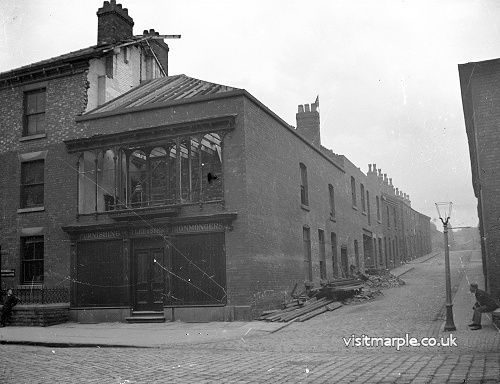
A new building emerges from the rubble later in 1902.
But some surprises do come in Lloyd's attribution of blame for the consequences of the explosion, in which he does not mince any words. He states that Lee, as the manager of the shop, bore the main responsibility for the infringements of the Act and the neglect of precautions. However, whilst acknowledging that ignorance of the law is no excuse, he had formed the view that Lee was of sound character and believed that had he been properly informed of the requirements of the Act then he would have been eager to comply. He therefore concludes, "Morally perhaps, Lee was not so much to blame" then continues, "I regret that I cannot say the same of the Local Authority and their officer, Superintendent Oldham of the Cheshire constabulary."
The Inspector goes on to explain in his report that Superintendent Oldham was appointed Officer by the Justices for the Stockport Division of the County of Chester in 1894, eight years earlier, yet he admitted at the inquest that he had never inspected these premises at all, offering the excuse that they were registered before he was appointed officer. Captain Lloyd wrote with considerable venom, "For this grave neglect of duty, I consider that he is deserving of the strongest censure, as I consider that the chief blame for this young man's death rests upon him. There is no doubt but that had the provisions of the Act been strictly enforced the accident would not have occurred, and it was his duty to see that they were so enforced."
Lloyd has similar feelings about the Local Authority, adding, "Only second to the Officer in culpable neglect is the local authority, who, having appointed an officer, left him to do as he pleased, and took no steps to see whether he was doing his duty."
The verdict of the jury at the inquest was that the deceased met his death accidentally through throwing a match on the floor, which communicated by a train on the floor to the safe in which the gunpowder was kept. Despite his report's condemnation of the Local Authority and its Officer it appears that they got away without the censure that Captain Lloyd felt was due.
BOYS WILL BE BOYS!
Captain Lloyd added a four page appendix at the end of his report that listed all the accidents that had occurred on registered premises since the Explosives Act 1875 came into force. There were 102 of them up and down the country in the 17 year period up to 1902, resulting in 42 fatalities and more than 110 persons injured. So Robert Lee was simply one of many.
The list of accidents included a brief description identifying the cause of each and to finish on a lighter note, and hopefully it's ok to do that looking so far back in time, here are some highlights, if that's the right word!
"Boy was getting powder for a customer by candlelight, when explosion occurred."
"Boy dropped a lighted candle-wick into an open powder keg which was in the shop."
"Man lit gas and threw match amongst some exposed fireworks, which ignited."
"Child got some Roman Candles out of shop, and threw them on the fire in the sitting room."
"Boy entering garret where powder was kept dropped a lighted match on the floor and ignited scattered grains of powder, communicating explosion to contents of a barrel."
"Girl lit gas and threw burning paper away. It fell into a tin of gunpowder."
"Boy lit with a match some gunpowder sweepings on the floor. Flash communicated with about ½ lb. of gunpowder in a bag."
"Boy dropped a match into an old biscuit tin containing ½ lb. of damaged gunpowder. He died from syncope shortly after explosion."
"Boy got hold of 'garden alarm,' and tried to open it."
"Boy threw a lighted firework into shop while gunpowder was being served."
And my favourite:
"The explosion originated in filling room in which a boy was present. Some nitro-powder fired and communicated with gunpowder in safe. Probably schultze powder spilt on floor ignited by being trodden on, or by boyish experiment."
You'd be forgiven for thinking that perhaps the real problem was not gunpowder at all but small boys!
You can read a scanned "text recognition" version of the full report and appendix by clicking the cover below, or by downloading this pdf file copy of the report.

Cover of the original copy of Captain Lloyd's report from MLHS archives.
Thanks to Bill Beard and Hilary Atkinson for their help and for inspiring this article.
Do you have anything interesting to share with the local community?
If you have anything to share about Marple's history and heritage, including photos for the Virtual Tour, or if you would like to submit an article for publication on the site please get in touch using the contact page.
